
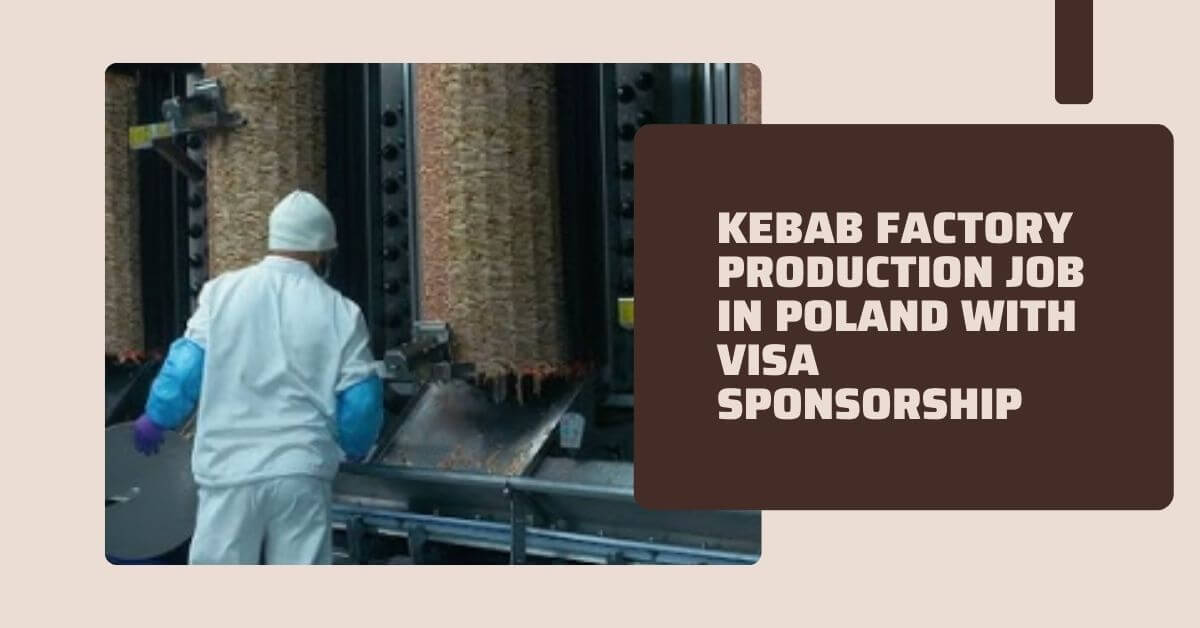
Imagine securing a job that doesn’t just offer a paycheck, but a fully-supported gateway to a new life in Europe. For thousands of foreign workers, this dream is becoming a reality in Poland’s thriving food production industry.
Kebab factory jobs are in high demand, and employers are actively seeking motivated individuals, offering an incredible package that includes visa sponsorship, free accommodation, and a competitive hourly wage of 28 PLN.
This is more than just a job; it’s a stable, secure opportunity to build a future in the heart of the EU, with no prior experience required. If you’re a man or woman between 23 and 47 looking for a rewarding path abroad, your journey starts here. Discover everything you need to know to apply.
Why Choose Kebab Factory Jobs in Poland?
The text outlines a compelling case for foreign workers, particularly those from outside the EU, to consider jobs in Poland’s kebab production industry. The appeal is a combination of strong practical benefits and Poland’s position as a growing European economy.
Here’s a breakdown of the key reasons, expanded upon for clarity:
1. Significant Practical and Financial Benefits
This is the core of the offer and is designed to be highly attractive to job seekers.
- Visa Sponsorship: This is the most critical factor for non-EU citizens. Navigating work permits and visas alone is complex and expensive. Having an employer handle the legal paperwork and sponsorship removes a massive barrier to entry, making it possible to work legally in the Schengen Area.
- Free Accommodation: This is a major financial incentive. Housing is typically one of the largest monthly expenses. By providing it for free, employers drastically reduce the cost of living, allowing workers to save or send home a much larger portion of their salary.
- Competitive Wage: An hourly rate of 28 PLN is strong for unskilled labor in Poland, especially when combined with free accommodation.
- Context: The Polish minimum wage is 4,300 PLN/month (gross). A monthly gross salary of 1,872 – 2,340 PLN for a part-time schedule (24 hrs/week) is below this, but the net take-home pay would be close to the gross due to specific tax treaties for short-term foreign workers. It is crucial to confirm with the employer if the stated wage is gross or net.
- Saving Potential: The text correctly highlights that with free housing, a worker’s disposable income is much higher, making the effective value of the salary significantly better than a higher nominal wage in a country with high rent costs.
2. Low Barriers to Entry
The industry is designed to be accessible to a wide range of people.
- No Experience Required: Employers provide full training. This opens doors for people looking for their first job abroad, a career change, or an opportunity without specific prior skills.
- Inclusive Hiring: The explicit mention that jobs are open to both men and women across a wide age range (23-47) indicates that physical demands may be manageable and that the industry seeks a diverse workforce.
3. Job and Industry Stability
The text makes a strong argument for the reliability of this work.
- Constant Demand: Food production is an essential industry. Unlike seasonal tourism jobs, the demand for kebab products in restaurants and supermarkets is year-round. This translates to more stable, long-term employment contracts and consistent hours.
- Growing Market: Kebab is immensely popular across Europe. Being part of a “growing segment” suggests opportunities for ongoing work and potentially more openings in the future.
Details of Kebab Factory Production Job in Poland:
- Job Title: Factory Worker / Kebab Production Worker / Food Production Worker
- Job Location: Poland
- Expected Salary: 28 PLN/hour (≈ PLN 1,872 – 2,340 monthly)
- Accommodation: Free (shared housing provided)
- Food: Not free (at applicant’s expense)
- Experience Required: None
- Age Limit: 23–47 years
- Visa Sponsorship: Yes
Key Responsibilities of Kebab Factory Production Job in Poland:
The role involves various tasks in the kebab production process, including:
- Kebab Forming: Arranging and preparing meat on skewers according to specific recipes.
- Packaging & Labeling: Wrapping finished products, boxing them, and applying correct labels.
- Quality Control: Ensuring products meet strict hygiene and safety standards.
- Warehouse Duties: Sorting, stacking, and managing inventory.
- Dispatch: Assisting in preparing orders for shipment to retailers and wholesalers.
Who Can Apply?
This opportunity is designed to be highly accessible:
- Gender: Open to both male and female applicants.
- Age: Must be between 23 and 47 years old.
- Physical Ability: Must be physically fit for manual tasks, lifting, and standing for long periods.
- Attitude: Employers seek reliable, punctual, and motivated individuals willing to work in a fast-paced environment.
Benefits of Kebab Factory Production Job in Poland:
This package is highly attractive for foreign workers due to its comprehensive support:
- Visa Sponsorship: The employer handles the work visa and permit process.
- Free Accommodation: Shared housing is provided, drastically reducing living costs in Poland.
- Competitive Wage: The hourly rate of 28 PLN is strong for an entry-level position, especially with free housing.
- No Experience Needed:Full on-the-job training is provided, making it ideal for those seeking a new start.
- Stable Industry: The demand for kebab products remains consistent, offering job security.
- Foot in Europe: A Polish work permit allows for travel within the Schengen Area.
Why Poland is a Strategic Choice for This Work?
Beyond the job itself, Poland is a strategically advantageous destination for foreign workers.
- Affordable Cost of Living: While Warsaw and Kraków are becoming more expensive, Poland remains significantly cheaper than Western European countries like Germany, France, or the Netherlands. A worker’s salary goes much further for daily expenses, food, and leisure.
- Central European Location: As a member of the EU and Schengen Area, Poland serves as a perfect base for traveling and exploring other European countries on weekends or holidays.
- Growing Economy: Poland has one of the most robust economies in the EU, which means a higher number of available jobs and a developed infrastructure for integrating foreign workers.
- Large Expatriate Communities: Major cities have established communities from Ukraine, Belarus, Nepal, India, and others, making it easier to find support, familiar food, and social connections.
Visa Requirements:
1. Job Offer & Sponsorship
- A valid employment offer from a Polish kebab production factory or employer is required.
- The employer must provide a signed contract stating salary, duties, and working conditions.
2. Work Permit (Zezwolenie na Pracę)
- The employer must apply for a work permit on your behalf before you can legally work in Poland.
- Common types include:
- Type A: For foreign workers employed directly by a Polish company.
- Type B: For board members working over 6 months in a year.
- Type C–E: For transfers from abroad.
- Most kebab factory jobs fall under Type A work permits.
3. Visa Application (National Visa – D Type)
- After receiving a work permit, you must apply for a National (D) Visa at the Polish consulate in your country.
- Required documents usually include:
- Completed visa application form
- Valid passport (at least 12–18 months validity)
- Job offer and signed work contract
- Work permit approval
- Passport-size photographs
- Proof of accommodation in Poland
- Proof of financial means (if requested)
- Health insurance coverage
4. LMIA Equivalent (Poland)
- Unlike Canada, Poland does not require an LMIA. Instead, employers may need to show that they cannot find local workers for the role before hiring foreigners.
5. Medical & Police Clearance
- Some consulates may ask for a medical certificate proving you are fit for work.
- A police clearance certificate may be required to ensure no serious criminal background.
6. Residence Permit (Optional After Arrival)
- Once in Poland, you may apply for a Temporary Residence Card (Karta Pobytu) if you plan to stay long-term. This allows legal residence beyond your initial visa validity.
How to Apply For Kebab Factory Production Job in Poland with Visa Sponsorship?
The application process is straightforward:
- Prepare a Simple CV:Highlight any work experience (even outside manufacturing) and emphasize your reliability and physical fitness.
- Use Trusted Job Portals: The most recommended site is Schengen.work. Also check:
- Indeed Poland
- Pracuj.pl (Use Google Translate.)
- LinkedIn (Search for “Kebab Factory Poland Visa Sponsorship”)
- Search and Apply:Use keywords like “Kebab Production,” “Food Factory Worker,” or “Visa Sponsorship Poland.”
- Submit Application: Fill out the online forms and upload your CV.
- Wait for Offer: If selected, you will receive a job offer letter to begin the visa process.
Important Considerations:
- Net Salary: The monthly estimate (1,872 – 2,340 PLN) appears to be based on a 24-hour workweek. A standard 40-hour workweek would yield a higher gross income (approx. 4,480 PLN), but deductions for taxes and social security would apply. Clarify the expected number of weekly hours with the employer.
- Cost of Living: While accommodation is free, budget for food, transportation, and personal expenses. Poland is relatively affordable, but your disposable income will depend on your lifestyle.
Conclusion:
A kebab production job in Poland is one of the most accessible and supported routes to building a career and life in the European Union. The powerful combination of visa sponsorship, free accommodation, and a competitive wage removes the biggest obstacles faced by foreign workers. For anyone seeking stability, a chance to save money, and a foothold in Europe, this is an opportunity not to be missed.
Frequently Asked Questions
Is the salary of 28 PLN/hour gross or net?
This is critical to confirm with the employer. Always ask if the wage is stated as gross (before tax) or net (take-home pay). Poland has specific tax rules for foreign workers that can be favorable.
How many hours can I expect to work per week?
estimates based on a 24-hour week. However, many factories offer standard 40-hour weeks or overtime. Clarify the expected weekly hours and overtime rates during your interview